There’s something almost nostalgic about it: sitting in the bleachers on a warm summer evening, a transistor radio pressed to your ear, listening to your favorite play-by-play announcer call the very game you’re watching in real time. The crack of the bat, the roar of the crowd, and then — half a second later — the broadcaster’s voice describing exactly what you just saw.
That experience didn’t disappear because fans stopped wanting it. It disappeared because technology moved on without accounting for it.
Today, streaming audio is the dominant delivery method for radio broadcasts. And while that’s been a tremendous development for reach and accessibility, it comes with a side effect that makes in-stadium listening essentially broken: latency. Most streaming audio runs 18 to 30 seconds behind real time. That gap might be invisible when you’re sitting on your couch, but in a stadium — where you can see the play unfold right in front of you before the audio catches up — it’s disorienting enough to make the whole experience unusable.
The good news is that this is a solvable problem. And StreamGuys has solved it.
Why This Matters More Than You Might Think
Every sports club says, “Yes, we have those fans! The ones who want to listen to the broadcast while they’re in the building. They’re some of our most dedicated, most passionate supporters. We’d love to serve them, but we don’t know how.”
And increasingly, the reasons to solve this go well beyond satisfying a niche group of superfans. When a fan downloads your app specifically to access the in-venue audio experience, you gain a foothold on their device that opens up a whole range of new touchpoints. Push notifications for upcoming games and ticket sales. Merchandise promotions. Access to your broader audio and video network. The app becomes a relationship — and that relationship starts because you gave them something valuable in the moment they were most engaged: sitting in your stadium, watching your team.
What’s Actually Causing the Delay — and How We Fix It
To understand the solution, it helps to understand the traditional broadcast chain.
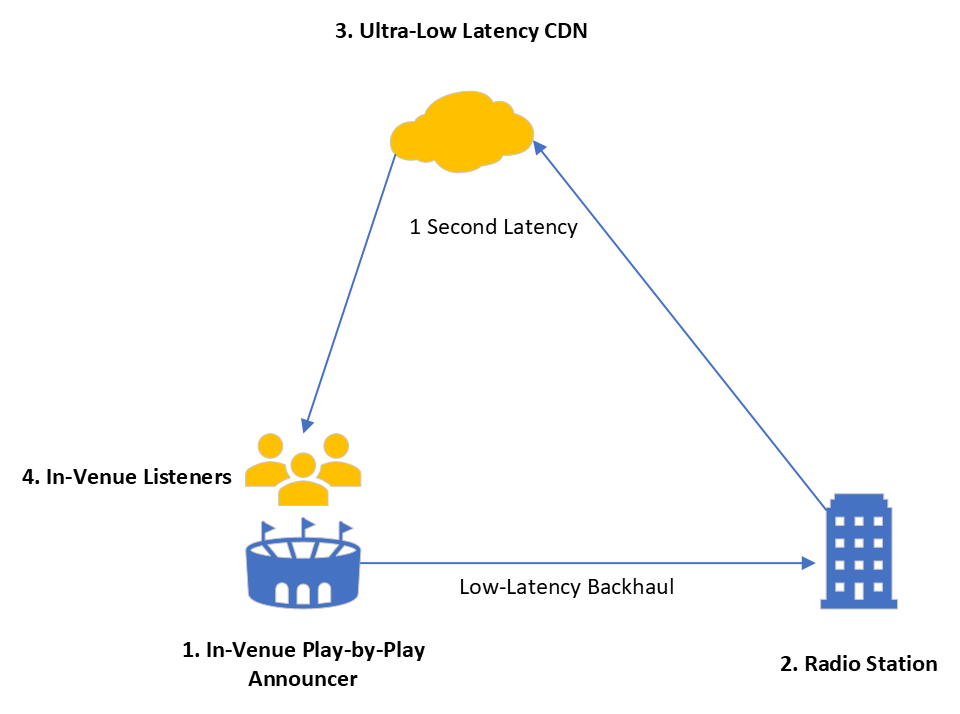
When a play-by-play announcer calls a game from the press box, that audio often travels from the venue to a radio station, where it’s produced into a full broadcast — spots, music, the works — and then sent up to a transmitter. Every link in that chain operates at near-real-time latency. That’s why AM and FM radio worked so well for in-stadium listening for decades.
Streaming broke that chain. When the broadcast leaves the radio station and enters a streaming provider’s infrastructure, the latency introduced at that stage alone is typically 18 to 30 seconds. That’s not a bug — it’s actually a byproduct of how HTTP-based streaming protocols like HLS were designed, optimizing for reliability over immediacy. For most use cases, it’s fine. For someone sitting in Section 114 watching a pitcher wind up while the broadcast is still describing the play from two batters ago, it’s a deal-breaker.
Our low latency solution replaces that final leg of the chain. The audio still travels from the venue to the radio station the same way it always has. But instead of going into a traditional streaming pipeline, it flows into our ultra-low latency infrastructure — and from there to listeners with end-to-end latency of around one second.
One to two seconds feels like real time. Eighteen to thirty seconds does not.
How It Works in Practice
One of the things we’re most proud of about this solution is how straightforward the technical integration is, especially on the contribution side.
If you’re already encoding audio for streaming — and virtually every broadcaster is — you almost certainly don’t need to change or replace anything. Our system accepts any standards-based input: SRT, RTMP, traditional Icecast, and more. Comrex, Telos, Barix, and most other broadcast encoders you’re likely already using will work. You simply add another output from your existing encoder pointing to our infrastructure. There’s no ripping and replacing your existing workflow for external listeners. Your standard stream stays exactly as it is. The in-venue feed is just an additional output.
On the listener side, we provide an HTML5 media player that drops into virtually any website without significant development work. It supports MSE (Media Source Extensions), which is the browser standard that makes ultra-low latency streaming possible. For teams with dedicated apps, integration can happen two ways:
- iframe embed — the fastest path to getting it live, lowest barrier to entry, gets you operational quickly
- Full SDK — unlocks background audio playback, picture-in-picture, and a fully native look and feel within your app
Which path makes sense depends on your app provider’s capabilities and how deeply you want the experience integrated. We’ve worked with enough teams and vendors at this point that we can help navigate either direction.
Building in Revenue
In the last quarter, we’ve added something that changes the financial case for this investment considerably: audio pre-rolls built directly into the media player.
Before a listener connects to the live stream, a short audio spot plays — typically 15 seconds. This doesn’t add latency to the stream itself; the listener hears the ad, then connects to the live feed right where it is. Still a real-time experience, with a monetization layer on top.
Those pre-rolls can come from a few places. If your sponsorship team is already selling in-stadium inventory — signage, video boards, activations — adding an in-venue audio pre-roll to that package is a natural extension. Pre-rolls can also run through your existing ad server, whether that’s AdsWizz, Google Ad Manager, or another platform, with the same frequency capping and targeting rules you’d apply elsewhere. And for teams that have some direct sales but not enough to fill all the inventory, the StreamGuys Ad Network can serve as a secondary position in the waterfall — we take the remnant inventory, sell it, and provide a revenue split.
Beyond audio, the player itself has visual real estate available for sponsor logos and messaging, giving your sponsorship team another asset to package and sell.
The Data You Gain
One of the quieter but meaningful benefits of moving in-venue listening to a streaming environment is what you learn about your audience.
With traditional over-the-air radio, listening data is aggregated, delayed, and often incomplete. You might get ratings numbers at the end of a season if you’re lucky. You almost certainly don’t know which of your fans were listening at the game versus at home, or for how long, or on what devices.
With streaming, that changes entirely. SGreports, our analytics platform, gives you a live view of concurrent listeners, session duration, device type, and geographic distribution. You can see which games drive the most audio engagement. You can see whether fans are staying connected through the whole game or dropping off at halftime. Over time, this becomes a genuinely useful signal for understanding your audience — not just for in-venue audio, but for your broader streaming strategy.
Who’s Already Doing This
This isn’t theoretical. Teams and broadcasters across professional, college, and minor league sports are already running ultra-low latency in-venue streams today.
It’s not just for in-venue synchronization, but to let TV viewers sync their preferred radio commentary with the live broadcast.
That last use case is worth highlighting because it illustrates something broader about what low latency streaming enables. Any time you want two audio experiences to be synchronized — with live video, with another broadcast, with real-world events — this technology makes it possible.
Common Questions
“What’s the typical latency?”
In real-world deployments, we consistently see latency in the one-to-two second range. We say two publicly to build in a realistic buffer, but it’s often closer to one.
“Does this work for video, not just audio?”
Yes. The same protocol support that applies to audio applies to video, including support for CEA-608 caption pass-through.
“Can we use our existing ad server?”
Absolutely. Third-party ad servers are fully supported, or we can provide one. The pre-roll framework is designed to integrate with your existing ad operations stack.
“Can it scale?”
We’re handling these deployments at 10,000’s of concurrent listeners today. The architecture scales cleanly — unlike WebRTC-based approaches that require significant compute overhead at high concurrency.
“Can the stream be geofenced to the venue?”
Geofencing is fully supported if it’s a requirement, either at the streaming server level or within the app. That said, our recommendation in most cases is to handle this through the app experience rather than a hard block. If a fan is outside the stadium, you probably want to serve them a different stream rather than show them an error. Pointing different users to the right stream based on location tends to create a better experience than simply restricting access.
Ready to bring back the in-venue listening experience for your fans? Contact us below to get started.